Monday, September 30, 2019

How automation and artificial intelligence will affect your job

We've long heard that robots are set to take over our jobs, but now new research has revealed which careers are actually at risk and which are future-proof - and they're not necessarily the jobs you would think.
Over the next five years, it's being predicted that more than 13,500 fewer secretaries will be hired - and sales assistants are also declining fast due to automation.
"We are seeing the rise of automation and artificial intelligence, and this will definitely have an effect on the sort of jobs that we're seeing," said Managing Director of People2People Recruitment Erin Devlin.
"But we don't need to panic yet - because there are going to be a lot of jobs that will replace those that we're used to doing."

Jobs in decline

Sales assistants have dropped 23 per cent between 2016 and 2019, topping the list of jobs with the worst decline - but white-collar management positions are also under threat.
"The first jobs to go will be those that are routine and process-oriented, so we're going to see those easily replaced with computers and artificial intelligence," Devlin said.
"But if you're in a job that has a human element to it as well, such as a policeman or beautician or Human Resources professional, those sorts of jobs are much harder to replace with computers.
"It's also a reflection on us as consumers - previously, we'd walk into a store and ask a sales assistant about the benefits and features of a product. But now we've got better access to data, so we're doing that research before we even go into the store."

Jobs on the rise

The list of Australia's fastest-growing jobs includes advertising and PR managers, software and applications programmers, accountants, and primary school teachers.
Overall employment is predicted to grow by seven per cent, or 886,100 jobs, with many of these likely to be part-time roles.
"In the workforce, we're seeing an increase towards flexible and casual work and even part-time work, and people are choosing these for lifestyle reasons," Devlin said.
"Jobs that are centred around data, automation and artificial intelligence are also on the increase.
"As we move towards a slightly more wealthy situation for some people, we're also going to see an increase in health and fitness, beauty and education."
Copyright Read More on 7NEWS.com.au

Friday, September 27, 2019

Apple researchers develop AI framework that leverages users’ intents to automatically label data

Apple researchers develop AI framework that leverages users’ intents to automatically label data

Personal assistants like Apple’s Siri accomplish tasks through natural language commands.

However, their underlying components often rely on supervised  algorithms requiring large amounts of hand-annotated training data. In an attempt to reduce the time and effort taken to collect this data, researchers at Apple developed a framework that leverages user engagement signals to automatically create data-augmenting labels. They report that when incorporated using strategies like multi-task learning and validation with an external knowledge base, the annotated data significantly improve accuracy in a production  system.
“We believe this is the first use of user engagement signals to help generate training data for a sequence labeling task on a large scale, and can be applied in practical settings to speed up new feature deployment when little human-annotated data is available,” wrote the researchers in a preprint paper . “Moreover … user engagement signals can help us to identify where the digital assistant needs improvement by learning from its own mistakes.”
The researchers used a range of heuristics to identify behaviors indicating either positive or negative engagement. A few included tapping on content to engage with it further (a positive response), listening to a song for a long duration (another positive response), or interrupting content provided by an intelligent assistant and manually selecting different content (a negative response). Those signals were selectively harvested in a “privacy-preserving manner” to automatically produce ground truth annotations, and they were subsequently combined with coarse-grained labels provided by human annotators.
In order to incorporate the coarse-grained labels and the inferred fine-grained labels into an  model, the paper’s coauthors devised a multi-task learning framework that treats coarse-grained and fine-grained entity labeling as two tasks. Additionally, they incorporated an external knowledge base validator consisting of entities and their relations. Given the prediction “something” as a music title and “the Beatles” as a music artist for the query “Play something by the Beatles,” the validator would perform a lookup for the top label alternatives and send them to a component that’d re-rank the predictions and return the best alternative.
The researchers conducted two separate test sets to evaluate the tasks performed by the multi-task model, which they compiled by randomly sampling from the production system and hand-annotating with ground truth labels. They say that across 21 model runs, adding 260,000 training examples “consistently” reduced the coarse-grained entity error rate on a prediction task compared with the baseline for all amounts of human-annotated data. Moreover, they report that adding weakly supervised fine-grained data had a larger impact when there was a relatively small amount of human-annotated data (5,000 examples). Lastly, they report that for examples where any of the top model hypotheses passed the knowledge base validator, the fine-grained entity error rate dropped by around 50%. […]

Evolution of Learning is key to better Artificial Intelligence

key to better artificial intelligence

Since “2001: A Space Odyssey,” people have wondered: could machines like HAL 9000 eventually exist that can process information with human-like intelligence?


Researchers at Michigan State University say that true, human-level intelligence remains a long way off, but their new paper published in The American Naturalist explores how computers could begin to evolve learning in the same way as natural organisms did – with implications for many fields, including .
“We know that all organisms are capable of some form of learning, we just weren’t sure how those abilities first evolved. Now we can watch these major evolutionary events unfold before us in a virtual world,” said Anselmo Pontes , MSU computer science researcher and lead author. “Understanding how learning behavior evolved helps us figure out how it works and provides insights to other fields such as neuroscience, education, psychology, animal behavior, and even . It also supplies clues to how our brains work and could even lead to robots that learn from experiences as effectively as humans do.”
According to Fred Dyer , MSU integrative biology professor and co-author, these findings have the potential for huge implications.
“We’re untangling the story of how our own cognition came to be and how that can shape the future,” Dyer said. “Understanding our own origins can lead us to developing robots that can watch and learn rather than being programmed for each individual task.”
The results are the first demonstration that shows the evolution of associative learning in an artificial organism without a brain.
“Our inspiration was the way animals learn landmarks and use them to navigate their environments,” Pontes said. “For example, in laboratory experiments, honeybees learn to associate certain colors or shapes with directions and navigate complex mazes.”
Since the evolution of learning cannot be observed through fossils – and would take more than a lifetime to watch in nature – the MSU interdisciplinary team composed of biologists and computer scientists used a digital evolution program that allowed them to observe tens of thousands of generations of evolution in just a few hours, a feat unachievable with living systems.
In this case, organisms evolved to learn and use environmental signals to help them navigate the environment and find food.
“Learning is crucial to most behaviours, but we couldn’t directly observe how learning got started in the first place from our purely instinctual ancestors,” Dyer said. “We built in various selection pressures that we thought might play a role and watched what happened in the computer.”
While the environment was simulated, the evolution was real. The programs that controlled the digital organism were subject to genetic variation from mutation, inheritance and competitive selection. Organisms were tasked to follow a trail alongside signals that – if interpreted correctly – pointed where the path went next. […]


Wednesday, September 25, 2019

Artificial Intelligence: a Game Changer in Manufacturing

SMART MANUFACTURING Artificial Intelligence: A game changer in manufacturing

Artificial Intelligence () has made a tremendous impact across a number of industries, including manufacturing. Manufacturing, as an industry, has matured over time; with  in the fold, the industry is set to radically evolve.


From the time the Industrial Revolution started, the focus of the manufacturing industry has been on reducing cost and the manufacturing time (time to market) by increasing operational efficiency and creating a safer work environment. Manufacturers have recently started focusing on improving the customer experience and making supply chains management even more complex. They are using the technology to make significant cuts in unplanned downtime to better design products.  has the potential to transform manufacturing tasks like, visual inspection, predictive maintenance and even assembly.  and its many perks
Manufacturing is a capital-intensive process. Once a plant is a set-up, replacing, removing or renovating is exorbitantly expensive. Monitoring results at each and every phase of the manufacturing process is possible because of .  also allows the organisation to take corrective measures at the initial stage. This allows businesses to save up on a lot, especially on the investments that are usually spent on rectifying damaged products or problems related to any machinery. Plus, it ensures predictive maintenance of machines and optimises usage of assets.  allows the organisation to take corrective measures at the initial stage
 has the potential to transform manufacturing tasks
Improvement in the performance can happen with new machines, equipment and processes and thus, reduce redundancies. This improves the overall quality metrics.  is proving to be an alternative to all of this and the price points are extremely competitive in nature. Manufacturing companies are finding it increasingly challenging to maintain high levels of quality and to comply with quality regulations and standards. This is because time-to-market deadlines are constantly decreasing. This is also because there is a rise in the complexity of products manufactured today.

Keeping product faults at bay

Today, a customer expects to have a product that is faultless. This is pushing manufacturers to use their quality matrices while understanding the damage that high defect rates and product recalls can do to a company and its brand. -based algorithms are used to notifying the manufacturing teams about the emerging production faults that are likely to cause product quality issues.

The rise of Quality 4.0

Data can be generated with the help of Quality 4.0. This data can help manufacturers know about the use and performance of their products available in the market. This information is important and crucial to the product development team, helping them make both strategic and tactical engineering decisions.

Making robots more efficient

Robotics, for the past couple of years, has become an integral part the manufacturing sector. There has been a considerable amount of improvement in the finesse, complexity, and sophistication of a task done by a  because of the advancements  has made. Tasks which were previously relegated to the human domain due to complexity and labour constraints are now routinely completed by robots. […]

Tuesday, September 24, 2019

Cisco Partners With SingularityNET on Decentralized Artificial Intelligence

Cisco Partners With SingularityNET on Decentralized Artificial Intelligence

Decentralized artificial intelligence (AI) firm SingularityNET and tech conglomerate Cisco have partnered to develop applied artificial general intelligence (AGI) technologies.
AGI is one aspect of AI technology that concentrates on learning the intellectual tasks of which humans are capable. Sometimes referred to as “Strong AI,” AGI emphasizes a machine’s ability to reason in uncertain situations, solve puzzles, plan and communicate in natural language. 
Goertzel also said that the scale of Cisco’s AGI deployments will be a major driver for the firm’s development, stating:
“The work we’ve done with Cisco on smart traffic analytics using OpenCog’s logical reasoning and deep neural networks just scratches the surface.  Let’s just say we have some much broader and deeper conversations going on.” 

Early applications

SingularityNET founder Dr. Ben Goertzel said that initial deployments of AGI may take the form of “Narrow AGI” systems that combine the tech into verticalized markets like advertising, medical research, computer networking and financial analytics.
Indeed, SingularityNET has already applied its technology in certain sectors. In May, the Singapore and Malaysia division of Domino's Pizza partnered with SingularityNET to use the blockchain-powered AI technology in its supply chain processes.
That same month, Chinese insurance giant Ping An partnered with the firm in a collaboration that will purportedly focus on optical character recognition, computer vision and model training. 
Dr. Goertzel has said that AGI will gain broad traction in the near future, stating, “In 10 years you’re going to see AGIs with IQs higher than humans.”

The brain in the machine

The brain in the machine

The phrase “” might conjure robotic uprisings led by malevolent, self-aware androids.


But in reality, computers are too busy offering movie recommendations , studying famous works of art , and creating fake faces to bother taking over the world.
During the past few years,  has become an integral part of modern life, shaping everything from online shopping habits to disease diagnosis. Yet despite the field’s explosive growth, there are still many misconceptions about what, exactly,  is, and how computers and machines might shape future society.
Part of this misconception stems from the phrase “” itself. “True” , or artificial general intelligence, refers to a machine that has the ability to learn and understand in the same way that humans do. In most instances and applications, however,  actually refers to , computer programs that are trained to identify patterns using large datasets.
“For many decades,  was viewed as an important subfield of . One of the reasons they are becoming synonymous, both in the technical communities and in the general population, is because as more data has become available, and  methods have become more powerful, the most competitive way to get to some  goal is through ,” says Michael Kearns , founding director of the Warren Center for Network and Data Sciences . “These are not what we would call ‘cognitive abilities,’” adds computer scientist Shivani Agarwal . “It doesn’t mean that the computer is able to reason.”
“These are not what we would call ‘cognitive abilities,’” adds computer scientist Shivani Agarwal. “It doesn’t mean that the computer is able to reason.”
If  isn’t an intelligent machine per se, what, exactly, does  research look like, and is there a limit to how “intelligent” machines can become? By clarifying what  is and delving into research happening at Penn that impacts how computers see, understand, and interact with the world, one can better see how progress in computer science will shape the future of  and the ever-changing relationship between humans and technology.

Intelligent machines?

All programs are made of algorithms, “recipes” that tell the computer how to complete a task. Machine learning programs are unique: Instead of detailed step-by-step instructions, algorithms are “trained” on large datasets, such as 100,000 pictures of cats. Machine learning programs then “learn” which features of the image make up a cat, like pointed ears or orange-colored fur. The program can use what it learned to decide whether a new image contains a cat.
Computers excel at these pattern-recognition tasks, with  programs able to beat human experts at games like chess or the Chinese board game GO, because they can search an enormous number of possible solutions. “We aren’t designed to look at 1,000 examples of 10,000 dimensional vectors and figure out patterns, but computers are terrific at this,” says Agarwal.[…]

Monday, September 23, 2019

Future of the Big Data and the Top 7 Successful Companies Which Already Use It

Older people sit down and ask, 'What is it?' but the boy asks, 'What can I do with it?'  - Steve Jobs was right. The new things we get every day have to be applied to real life otherwise they are pointless. This research we want to dedicate to the most successful Big Data startups and how to make money with Big Data. We also need to get acquainted with the trends in Big Data analytics to have all the insights while launching your own startup using Big Data. First of all, let's see what the numbers tell us about a future of BD.

What is the future of Big Data
The majority of modern companies all over the globe have already realized that the data they hold is a valuable strategic resource. According to the EIU research, about 60% of all organizations they surveyed already use data to generate profit. More than 80% uses data to improve their goods and services.
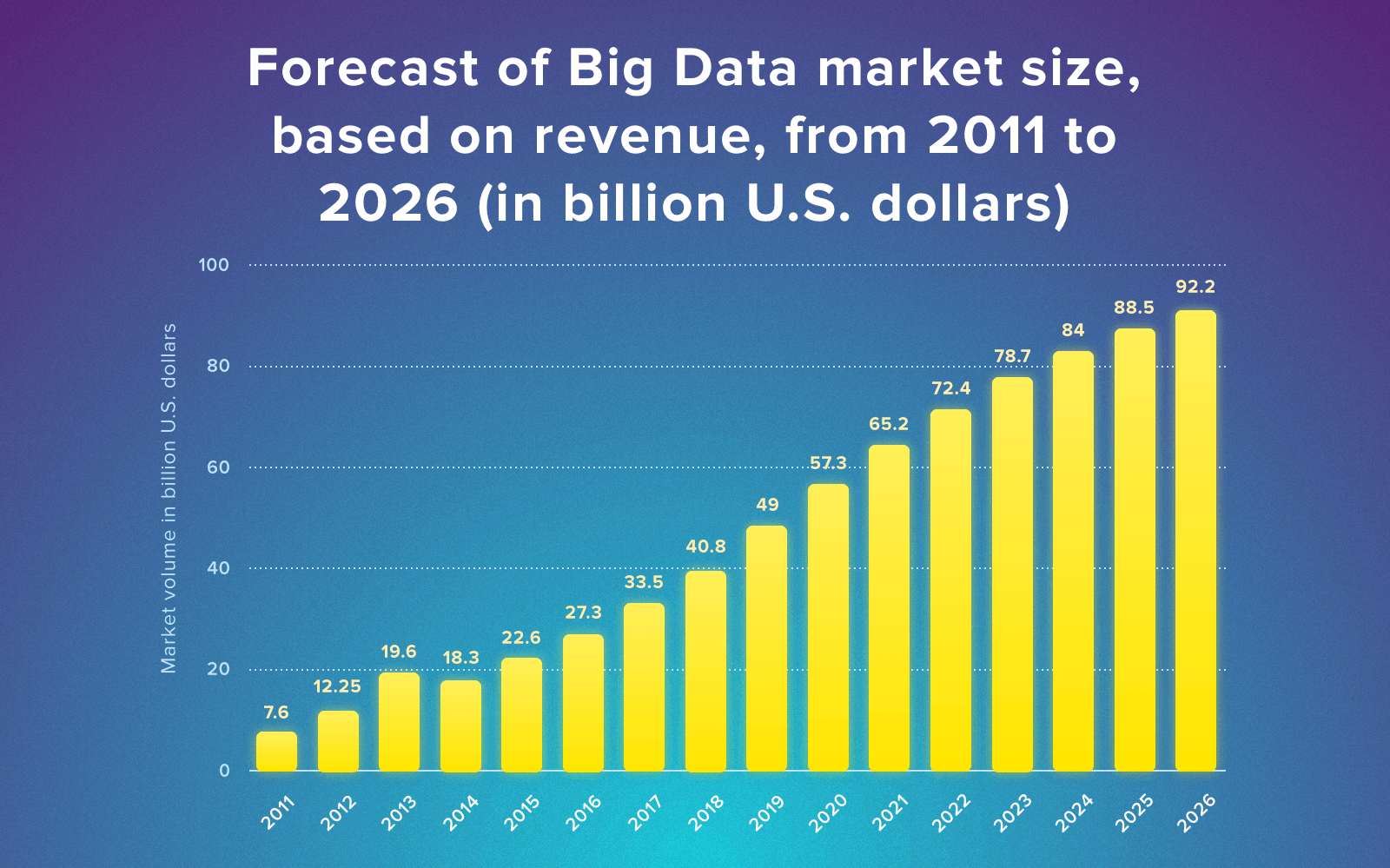
The Statista, reliable analytical portal, estimated that the revenue from Big Data and analytics market will reach $40 billion in 2018, $57 billion in 2020 and $92 billion in 2026.
big data analytics projects revenue
Revenue from Big Data companies
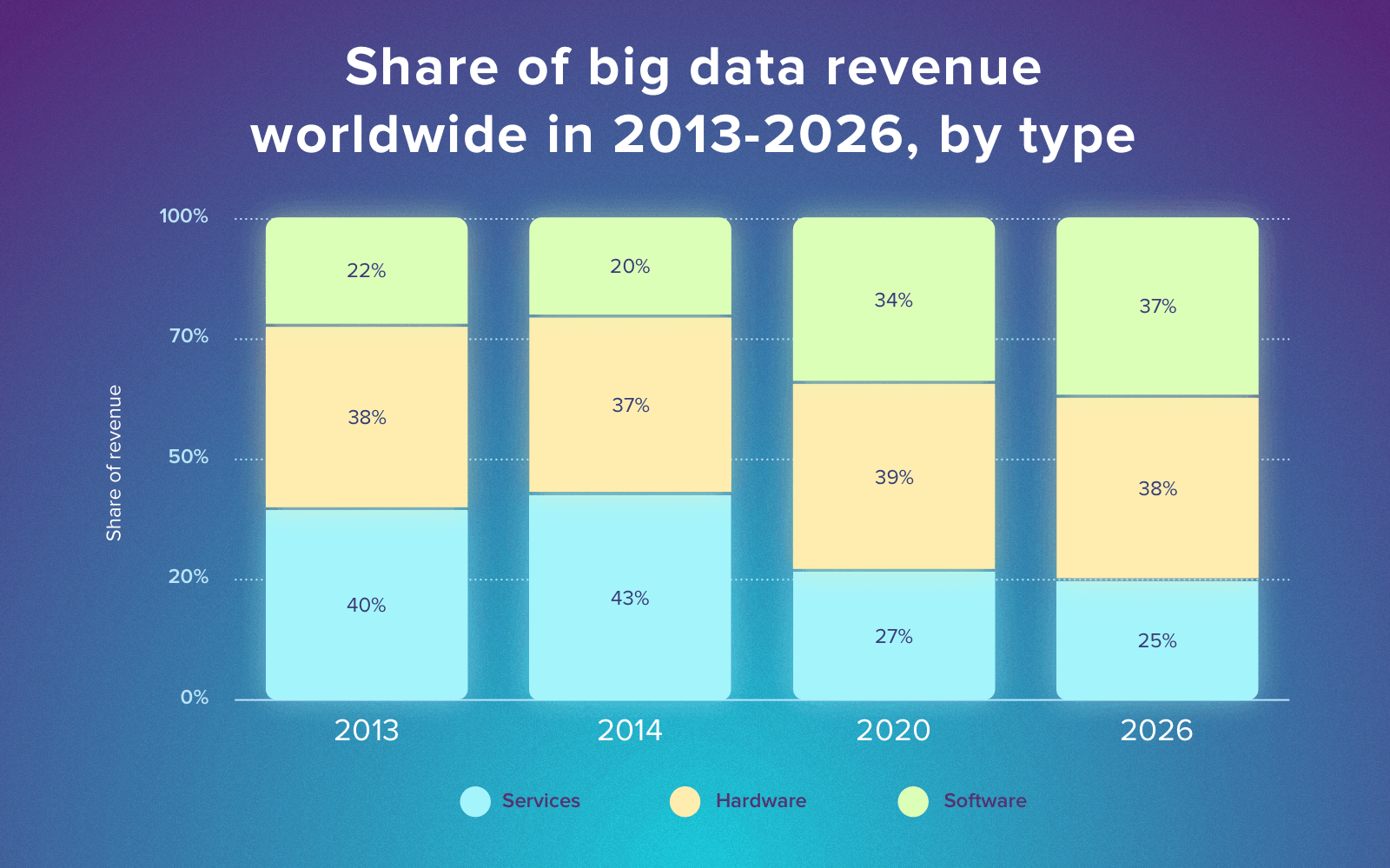
Statista also calculated the revenue by the type of Big Data startups. The revenue from services, hardware and software.
big data startup companies - revenue
Big Data revenue in 2013-2026
It all shows that data is a tool which can be turned into money. Big Data big money. At the same time, lots of company leaders admitted that they face difficulties processing such amount of information. They also state that these issues concern the effectiveness and security of data processing. As we know, organisations which built their business around customers data have to provide the highest level of this information protection. If users feel their data is being used improperly or has no appropriate protection, they will change a vendor immediately.
It brings us to an idea that the giant data flow and its proper processing is becoming an essential factor for the modern businesses. And this need leads to the development of new systems tools and approaches, which we call Big Data startups.
Some entrepreneurs have already taken advantage of this need and launched their businesses based on BD analysis. We will share these startups with you to prove that Big Data analytics projects are not only highly required but very profitable and successful as well.

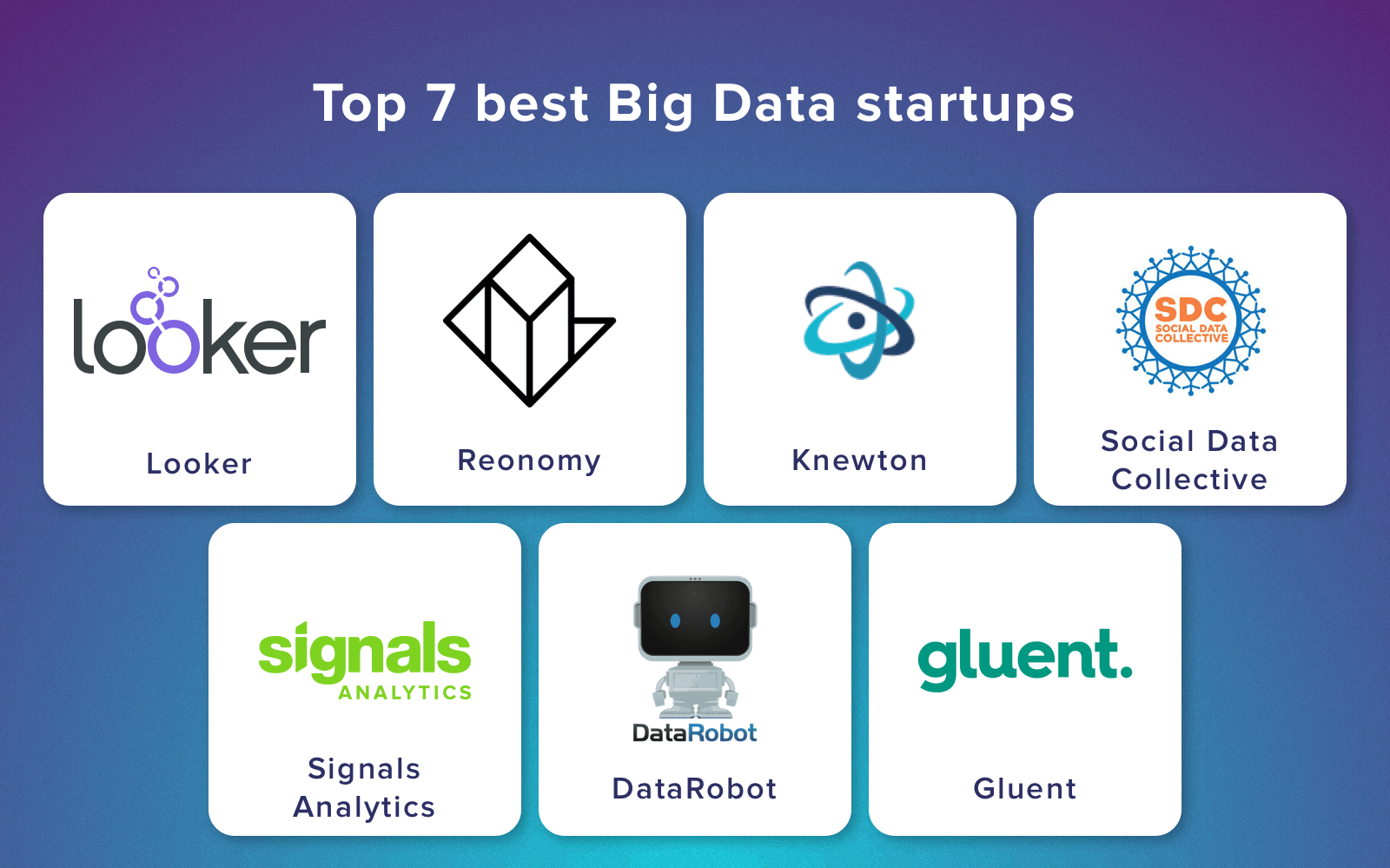
Top 7 best Big Data startups

To tell you the truth, there are so many companies successfully using Big Data and so many amazing Big Data startups that it was very difficult to choose only 7. However, we wanted to show you only the most successful and the most interesting ones. Let's get started.
top big data startups
Big Data startup companies

1. Looker

Looker is a Big Data analytics software company established in 2011. It provides software solutions which help different organizations with Big Data management. With this solutions, the process of data collection and processing become much easier. Moreover, the software improves data sharing among all departments.
The great advantage of this program is that even a non-professional person with no technical background can work with it rather successfully. It all led to a fact that now the company is more than 170 million dollar entity. Looker can also boast about its cooperation with such big dogs as Amazon and Sony.

2. Reonomy

Reonomy was established in 2013. The company is one of the leaders in Big Data analytics engaged in reals estate business. It collects data from all the possible sources and analyses it and incredibly fast. The main trick is in the speed. Working with CRE markets is often a slow and painful process. The information changes every second and Reonomy offers a great solution to change the experience of real estate business. The startup gathered more than $14 mln investments. Among the sponsor-companies are the Softbank Capital, Bain Capital Ventures and Fintech Collective.

3. Knewton

Knewton is an educational startup which was created in 2008. It offers PaaS solution which is based on the need for personalized education. The program applies Big Data approach and analyses all materials which a student used. After data processing, the system can offer those materials which a user can easily learn or those tasks which a student has to work on better. It offers such content which leads a student the best and the most efficient way for improvement. Today, more than 10 million students use it all over the world. The company has lots of supporters who invested over $150 mln in it.

4. Social Data Collective

Social Data Collective is extraordinary Big Data startup company which said out loud something that everyone has already known - data is actually money. It is a kind of currency you can convert to something real. That is exactly what the company does. They offer common people a prize (services and goods from their partners) for their personal information. The company explained it with the fact that we never get anything for our information but the companies always pay to the third parties for it. Why can't you simply sell it? And don't think that the company needs your passwords or addresses. No. Here you can share your browsing history, list of apps you use, financial transactions history and wearables or IoT devices you like. The system is simple, the more you share the more you earn. They call it personal data monetization.

5. Signals Analytics

Signals Analytics is the company, which was founded in 2009 offers businesses a solution which can guide them and actually tell them what to do.
The idea of a startup belongs to two military men, who value data and understand how little signs can influence the outcome of a situation. That is why they decided to apply AI to process all the company's data to predict the most plausible result of one action or another. The solution helps answer critical questions, analyses data and guides business owners in difficult situations. It is worth mentioning that such companies as Nike and Nestle already tested the system. They also helped the startup collect $30 million of investments.

6. DataRobot

DataRobot is a company, established in 2012, which deals with Machine Learning tasks. Its founders established an automated ML platform based on data science. The platform can be used to build very precise predictive models which allow business owners to save money on predictive analytics. The tool is so powerful that it raised $120 million in funding.

7. Gluent

The Gluent startup offers to process data in a brand new way. They call it 'hybrid data'. The idea is to upload data to Hadoop but to keep it accessible. Yet, the company was established in 2015 it already has lots of fans in the IT sphere. One of the biggest is Gartner company.

Driving Warehouse Management Innovation With Machine Learning

Driving Warehouse Management Innovation With Machine Learning

Machine learning is a form of  based on teaching neural networks to identify and adapt to known patterns on the fly.


Looking deeper into the core operations of warehousing ,  can apply to facility-wide production standards, optimize for specific metrics, and ensure a continuously improving user experience. How Does Machine Learning Tie Into Warehouse Management Systems?
Warehouses are dynamic environments. Machine learning software combines new and incoming information with pre-existing training to further hone pattern-based predictions including picking and routing info, customer demand, storage usage, and similar data sets to ensure all shipments are fulfilled on time .
Training neural networks with information from workers and historical data can identify ways in which workers can improve. While training machines can initially be resource-intensive, it is often less costly than hiring new human workers.
In the long-term,  can lower operational costs because training can be replicated on machines in a way that is not possible with humans who must be trained individually and on an ongoing basis.
Warehouse management systems (WMS) are an excellent application for  because consumer demand changes rapidly, causing overstocking and product scarcity in warehouses around the world. Overstocking is a particular concern because warehouse space availability is at 7% , the lowest since 2000.
Machine learning can not only predict these changes on the data side but can also accelerate the pace of adaptation on the production side. Production-side  encompasses storage optimization, picking routes, and even picking. Other facilities are evaluating  and machine vision applications in the docking and loading/unloading carrier shipments. Machines can also be used to optimize shipment aggregation and sorting processes as the technology matures.

How Does Machine Learning Improve Productivity?

Productivity metrics vary between businesses — some may favor order fulfillment over accuracy or vice versa, as well as a wide array of other potential indicators of productivity. Machine learning enables neural networks to break down whatever productivity expectations a business utilizes, recognize patterns, and enhance performance over time.
Common productivity metrics include:
  • Time to fulfillment
  • Fulfillment accuracy
  • Shipment utilization (fullness of carrier containers)
  • Idle time
Since their purchase of Kiva, Amazon has saved more than $22 million in each facility where Kiva robots are utilized for order fulfillment.
Other companies who reported success with  and warehouse automation include Merck, which achieved a 50% reduction in product carrying costs, and RRD, who helps other companies adapt to the  landscape. Ken O’Brien, Executive Vice President and Chief Information Officer of RRD, “What sets us apart is our ability to take these technologies — from  to business process automation to  — and demonstrate meaningful business results that improve our own internal processes and do the same for our clients.” […]

4 ways artificial intelligence is transforming African industries and communities – including by helping to diagnose eye disease

Dr Jacques Ludik.

From depression chatbots to diagnosing eye diseases, developers are coming up with incredible ways of teaching robots to transform the African industries they work in.
So says smart technology entrepreneur Jacques Ludik, founder of AI company Cortex Group and of the Machine Intelligence Institute of Africa.
“We’re seeing ground-breaking innovations taking place, not only on a business level, but on a community level.”
According to Ludik, artificial intelligence could be the powerful tool Africa needs to tackle its challenges, suck as shortcomings in health, education or employment.
While many people see robots as a potential threat to jobs, Ludik believes AI holds the key to uplifting communities, through education and economic development.
“Education is key to bridging the increasing gap of our experiences of the world, and improve and increase access to jobs (and other services) that aren’t bound by geography. AI, the very technology that is moving the rest of the world forward so rapidly, has the power to do that.”
AI is only as strong as the human behind it, and Ludik wants more people, and especially young people, to dive into the complex world of algorithms in order solve challenges in their communities.

Ludik gave us four examples where AI is breaking down barriers in Africa and transforming industries:

AI that can diagnose retinal diseases for free.


Nigerian-born Stephen Odaibo is using AI to better diagnose and treat retinal diseases using images of the retina, and to classify the type and stage of retinal disease, enabling better treatment.
His company RETINA-AI is training algorithms to classify the type and stage of the retinal disease.
“This could have a major impact in South Africa where blindness is a condition that severely impacts life opportunities,” said Ludik.
Odaibo is trying to address a major shortage of retinal specialists in the world.
A year ago the company released a mobile app for eye-care providers, which is free on the iStore. 


Jobs teaching AI in Cape Town townships. 


For machines to learn what they are seeing – be it an apple, a bottle of water or a shark - they need humans to label data first. That is a time-consuming process that requires humans to manually label objects over and over again, thousands if not tens of millions of times, depending on how sophisticated the AI is needed to be.  
Initiated by Pieter Boon of Cape Town AI, Enlabeler is a data labelling platform powered by people living in Khayelitsha, Cape Town.
"Its strong social upliftment credentials, allied to job creation and learning, are ground-breaking and could create thousands of jobs," said Ludik. 


Community development through schools in South Africa.


AI in Africa's aim is to expose children to technology using practical, hands-on learning in the disciplines of AI, robotics, virtual reality (VR), and the internet of things (IoT).
It forms part of the EduK∞ (Educate) Initiative, which is a social impact programme of the Kgalema Motlanthe Foundation and Fliptin Venture Builders, with the support of other partners.
"Without knowledge and education, nothing can change. I believe that initiatives like these are the right steps towards socio-economic development and inclusion. No sector or community must be left behind – we need more forward-thinkers and community leaders with a passion for and understanding of AI and how it can, not disrupt, but change lives,' said Ludik. 


AI battling depression and anxiety.   


Woebot is a mental health chatbot originally designed to interact with students showing signs of depression and anxiety. Since launch it has seen even engagement from users ranging from 16 to 102-years-old. The chatbot offers a 24/7 helpline to discuss how you feel and is currently being used in over 120 countries, including South Africa and Nigeria.
It was developed by Stanford psychologist and healthcare designer Alison Darcy, who wanted to addresses growing mental health concerns around the world.
The AI sends over a million messages per week to help users with everyday stress and challenges such as symptoms of depression, anxiety, relationship problems, procrastination, loneliness, grief, addiction, pain management.
It checks in with you every day and guides you through practical techniques based on tried and tested approaches such as cognitive behavioural therapy, mindfulness, and dialectical behaviour therapy.

Racial bias in a medical algorithm favors white patients over sicker black patients

A widely used algorithm that predicts which patients will benefit from extra medical care dramatically underestimates the health needs of...